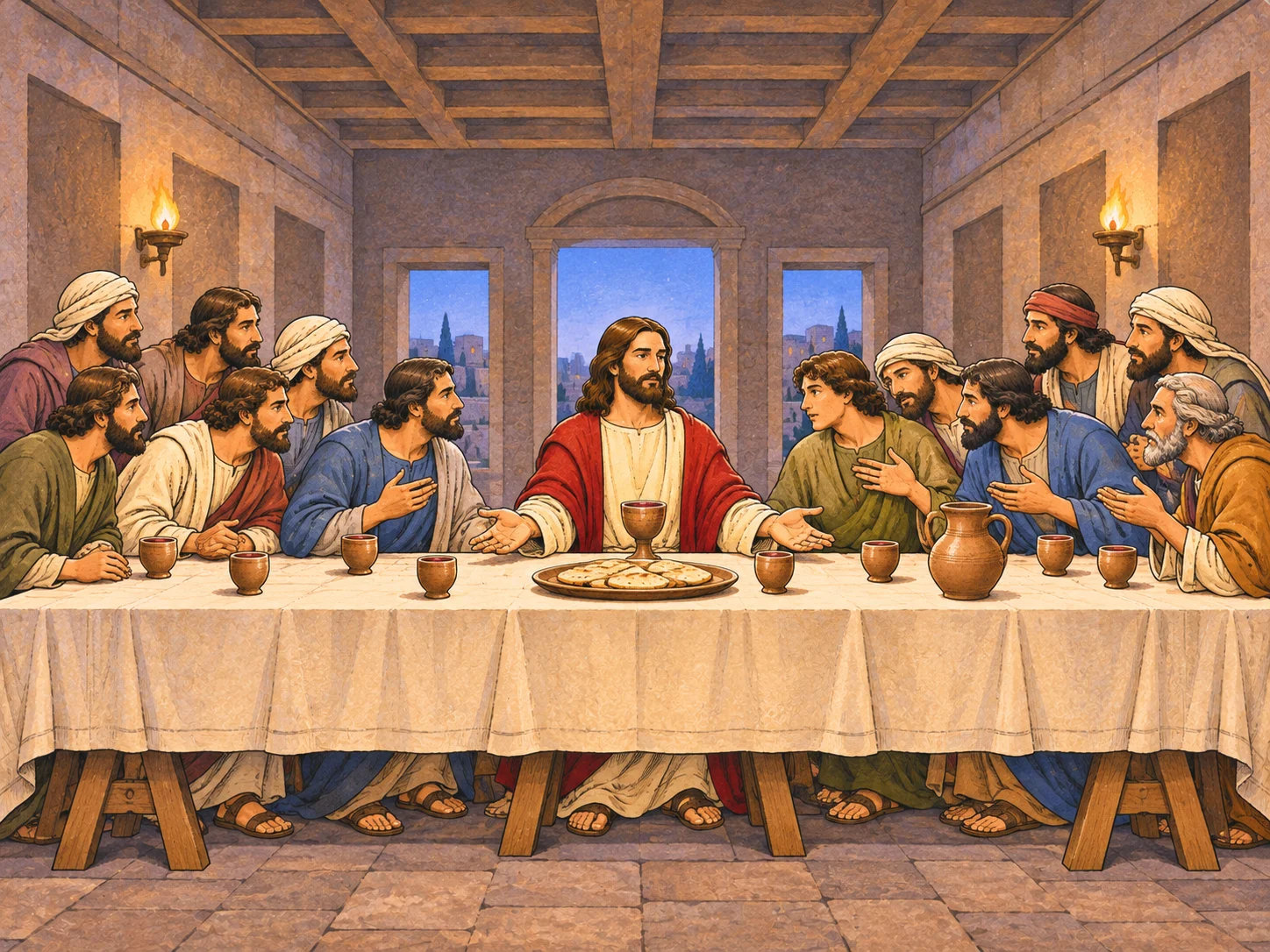
In the previous blog, we discussed the meaning of bread and wine at the last meal Jesus shared with His disciples. The drinking cup speaks of His blood and therefore of Him who died, but was raised from the dead by God.
The words Jesus spoke at this meal form the basis for what is called “Holy Communion” in Christian tradition. But did Jesus really institute a new ritual? Or did He do something entirely different?
an existing institution
In many Bible translations, a heading such as “The Institution of Holy Communion” appears above Matthew 26:26. But such headings are not part of the original Bible text. They were added by the translators. Sometimes these headings are very useful, but they can also be misleading. We should therefore not attribute the same authority to them as to Scripture itself.
If we read the passage from verse 17 onward, we see that Jesus celebrated a Passover meal with His disciples. He had instructed them to prepare the meal, and they did as He had commanded them (Matt. 26:17-19).
The Passover was not a new institution. It was a festival that JAHWEH had given to Israel centuries earlier, at the exodus from Egypt. The people were to remember and observe this day as a lasting institution (Ex. 12:14,17). Jesus therefore did not institute a new meal, but observed an existing institution.
this is My body
Matthew then describes what happened during that meal. While they were eating, Jesus took the bread, gave thanks, broke it, and gave it to His disciples. In doing so, He said: “Take, eat, this is My body” (Matt. 26:26).
The bread was therefore already on the table. Jesus took it, broke it to distribute it, and explained what it represented. He did not say that the bread was literally His body. It is figurative language, as we continually encounter in Scripture. For example, Paul says that the rock from which Israel drank was Christ (1 Cor. 10:4). Not literally, of course, but as a representation.
The bread also speaks of Christ. And its meaning goes much further than His physical body. Later, Paul would make known that believers together form the body of Christ, with Him as the Head (1 Cor. 12:12-13).
The one bread is a representation of that one body, in which all the members are connected to one another (1 Cor. 10:16-17).
do this in remembrance of Me
But Jesus said something else. Words that are often quoted as proof that He was instituting a new ritual.
1 Corinthians 11 (based on ISA)
²⁴ And giving thanks, He broke it and said: “This is My body for you. Do this in remembrance of Me.”
What did Jesus mean by “do this”? He was sitting at the table with His disciples and sharing bread with them. During that existing meal, He explained the meaning of what they ate and drank. He directed their attention to Himself and to what was about to happen.
He gave no instructions for a new ceremony. We read nothing about a separate ritual, a prescribed frequency, or a particular form in which it should be observed.
Regarding the drinking cup, He also says that they should do this in remembrance of Him, as often as they drink from it (1 Cor. 11:25).
The point is that bread and wine direct our attention to Him. To His death, but above all to the fact that He lives. Not as a separate ritual involving a piece of bread and a sip of wine that we “celebrate” in a religious setting, but at every meal where bread and wine are on the table. They remind us of Christ, who died and was raised by God.
not a funeral meal
The expression “in memory of Me,” as many translations render it, can easily evoke the idea of commemorating someone who has passed away. But notice what Paul says further on:
1 Corinthians 11 (based on ISA)
²⁶ For as often as you eat this bread and drink the cup, you proclaim the death of the Lord, until He comes.
Paul does not speak of the dying of the Lord, but of His death. And he adds: “until He comes.” That is significant. For the One whose death we proclaim is the One who will come. He was dead, but God raised Him, and He lives.
We are therefore not commemorating a deceased Lord. We proclaim the death of Him who has conquered death! Bread and wine are representations of the life and fellowship we have in the resurrected Christ.
Jesus did not give bread and wine a meaning at that moment that they had not had before. He made known to His disciples what they represented and how that would become reality in Him.
But what does this mean for the ecclesia? In 1 Corinthians 11, Paul discusses a shared meal that the believers in Corinth held. And quite a few things went wrong there.
What kind of meal was that, exactly? And why does Paul say that they ate and drank in an unworthy manner?
That is what the next blog is about.