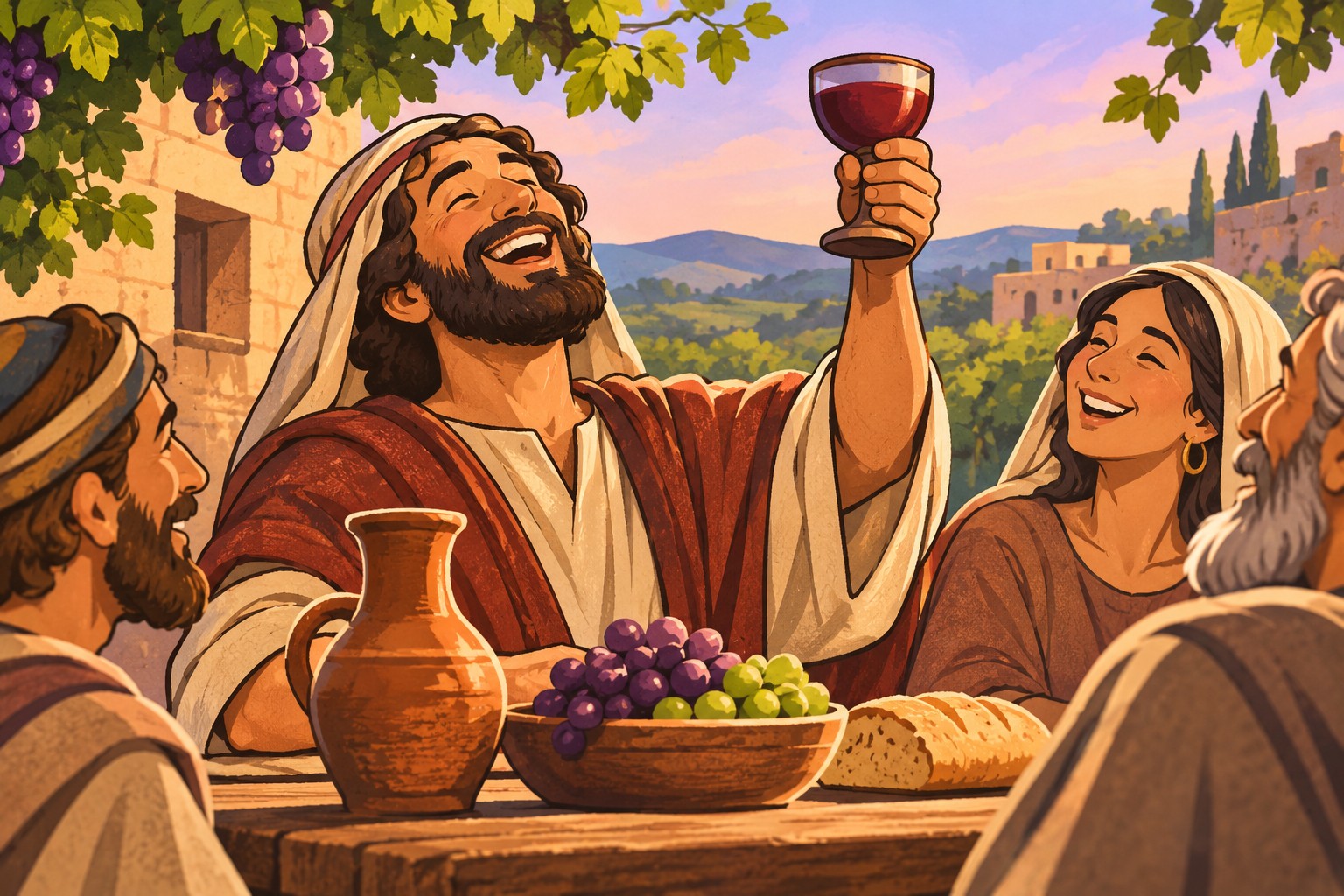
Why does Melchizedek bring forth both bread and wine? Why was Samson not allowed to drink wine? And why did Jesus turn water into wine at a wedding? These are accounts in which wine plays a special role. And that is not without significance. For in Scripture, wine is much more than a drink. It is a representation of life, joy, and abundance. And ultimately, wine points to the life that has conquered death: the resurrection life of Christ!
wine gladdens the heart
In Psalm 104, the psalmist praises the works of YAHWEH. He describes how God cares for His creation and brings forth food from the earth. Wine is also mentioned.
Psalm 104 (based on ISA)
¹⁴ He causes grass to sprout for the cattle, and plants for the service of mankind, to bring forth bread from the earth,
¹⁵ and wine that gladdens the heart of man, to make the face shine with oil, and bread that strengthens the heart of man.
Bread strengthens the heart of man, but wine does more. Wine gladdens the heart. Bread is necessary to stay alive, but wine speaks of the joy that is connected with life. We also find this in Ecclesiastes 9:7, where we are encouraged to eat bread with joy and drink wine with a cheerful heart.
lechaim
Wine is therefore explicitly associated with joy in Scripture. It is no coincidence that we raise our glasses on festive occasions. We make a toast and say: cheers! Or, as they say in Hebrew: lechaim! That means: to life!
That wine is associated with joy is also evident from the instructions God gave to Israel. In Deuteronomy 14:26, the Israelites were permitted to buy wine and strong drink, among other things, in order to celebrate and rejoice before JAHWEH. Wine therefore also had a place at the joyful meals of God’s people.
the first mention of wine
The first time wine is mentioned in Scripture is in the account of Noah. After the flood is over and Noah and his family have come out of the ark, he plants a vineyard.
Genesis 9 (based on ISA)
²⁰ And Noah, a man of the ground, began and planted a vineyard.
²¹ And he drank of the wine and became drunk, and he uncovered himself inside his tent.
It is remarkable that wine is mentioned for the first time after the flood. The judgment is over and there is a new beginning. The earth brings forth fruit again, and Noah plants a vineyard.
But the first mention of wine also has a darker side. Noah drinks of the wine and becomes drunk. He becomes intoxicated and uncovers himself in his tent. What exactly happened afterward and what its significance is fall outside the subject of this blog.
Adam, Noah and the last Adam
Adam had been appointed by God to rule over creation (Gen. 1:26-28), but he failed in this. And Noah, who stood at the beginning of a new world after the flood, also proved to fall short. He was not even able to control himself!
His name means rest, but he, too, could not bring true rest. The One who will truly reign and bring rest is Christ, the last Adam (1 Cor. 15:45).
Wine is a gift from God that gladdens the human heart, but drunkenness has precisely the opposite effect. We will encounter that distinction again later in this series.
bread and wine
The first time bread and wine are mentioned together is in Genesis 14. Abram has returned from his victory over the kings and is met by Melchizedek.
Genesis 14:18 (based on ISA)
¹⁸ And Melchizedek, king of Salem, brought forth bread and wine. And he was a priest of God, the Most High.
Melchizedek was both king and priest. His name means king of righteousness, and as king of Salem he was also king of peace (Heb. 7:2). In this, he is a beautiful foreshadowing of Christ, who is likewise King and Priest.
It is significant that Melchizedek brings forth precisely bread and wine. Bread that sustains life and wine that gladdens the heart. These are representations that point forward to Him who is Life and who, through His resurrection, has brought incorruptible life to light.
a promise of new life
Scripture speaks of the vine. This is actually a remarkable name, because wine does not grow on a vine at all. Grapes grow on it. Yet the plant is called a vine because the grapes are destined to produce wine. The vine, as it were, carries the promise of wine within itself. And with it, the promise of life and joy.
But that life is not the life we know now, which is finite and perishable. It points forward to the incorruptible life that Christ has brought to light through His resurrection (2 Tim. 1:10). He has conquered death!
And that life will ultimately be the portion of all creation. For just as in Adam all are dying, so also in Christ all will be made alive (1 Cor. 15:22). Now that is a reason for joy!
from grape to wine
What is remarkable is that wine does not simply grow on a vine. Before there is wine, the grapes must first be picked and pressed. Traditionally, they were trampled underfoot in a winepress for this purpose. The juice is collected and stored in vessels, where, hidden from sight, it undergoes a transformation. Eventually, the wine emerges as a spirituous liquid that gladdens the heart of man.
It is remarkable: grapes must first be trampled before wine can come forth from them. What begins with the crushing and trampling of the fruit ends with wine that gladdens the heart of man. In this, we recognize something of the path Christ took. He was humiliated, suffered, and died. But His death was not the end! God raised Him from the dead and brought incorruptible life to light.
How is this path from suffering and death to new life portrayed in the process from grape to wine? In the next blog, we will examine this more closely. For in the very way wine comes into being lies a remarkable reference to Christ and His resurrection.