In the previous blog, we saw how Jesus turned water into wine at the wedding in Cana. It was a representation of the new covenant that God will make with Israel. The old gives way to the new, and the best wine is kept until last.
On another occasion, Jesus also speaks about wine, using a remarkable comparison. New wine cannot be put into old wineskins. Why not? And what does He want to make clear by this?
the bridegroom is present
In Luke 5, we read that the disciples of John the Baptist fasted regularly, as did those of the Pharisees. But Jesus’ disciples did not. They ate and drank. Why the difference?
Jesus answers by referring to a wedding.
Luke 5 (based on ISA)
³⁴ And He said to them: Can you make the sons of the bridal chamber fast while the bridegroom is with them?
³⁵ But days will come, and when the bridegroom is taken away from them, then they will fast in those days.
Once again, we find the image of a wedding. Jesus presents Himself as the Bridegroom. And as long as the Bridegroom is present, there is no reason to fast. After all, a wedding is a festive occasion, when people eat and drink.
But Jesus also announces that the Bridegroom will be taken away. It is a reference to His approaching suffering and death.
new wine
Jesus then tells a parable. No one would tear a new garment to repair an old garment with it. For that would tear the new garment, and besides, the new patch would not match the old one.
Luke 5 (based on ISA)
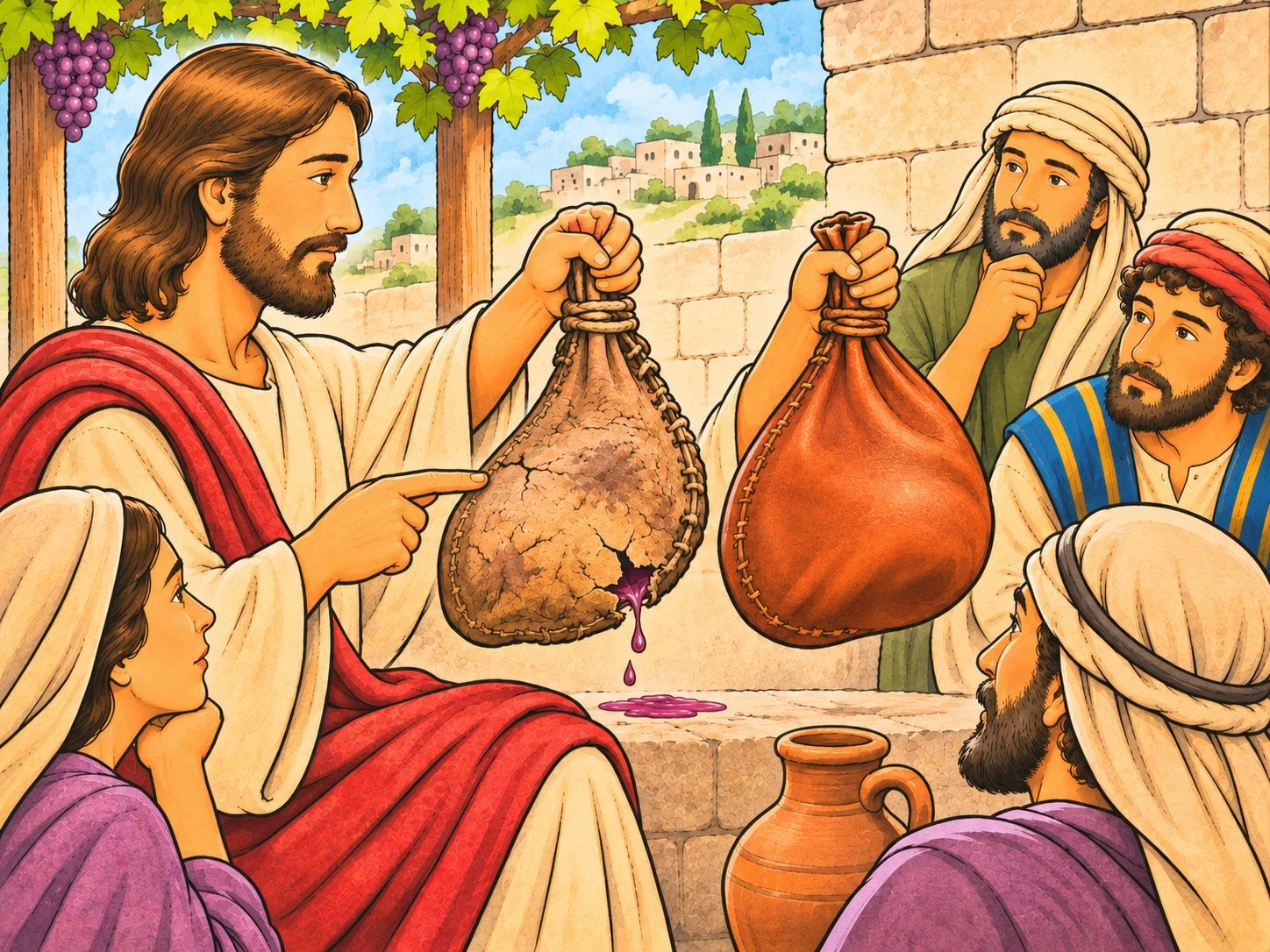
³⁷ And no one puts new wine into old leather wineskins. Otherwise, the new wine will burst the wineskins, and the wine will be spilled, and the wineskins will be ruined.
³⁸ But new wine must be put into new leather wineskins.
In those days, wine was stored, among other things, in leather wineskins. New wine is still developing, and during fermentation, gases are produced, causing pressure to build up.
New leather wineskins are supple and can expand. But old wineskins have lost their flexibility through use. When new wine is put into them, the increasing pressure can cause them to tear. Then both the wine and the wineskins are lost. New wine therefore requires new wineskins.
the old and the new
What does Jesus want to make clear with this comparison?
The teaching He brought did not fit within the existing religious system. The Pharisees clung to their regulations and traditions, but Jesus brought something new. After all, He Himself was the fulfillment of the promises God had given to Israel. In this, we also recognize the distinction between the old and the new covenant.
The old covenant was based on conditions that Israel had to fulfill. At Sinai, the people had declared that they would do everything JAHWEH had spoken (Ex. 19:8). But Israel proved unable to keep that covenant.
That is why God announced a new covenant through Jeremiah. A covenant in which the emphasis is not on the obligations of the people, but on God’s promises. He will put His law within them and write it on their hearts (Jer. 31:31-34).
The new covenant is not an improved version of the old. It is not a new patch on an old garment. The old gives way to the new. The writer of Hebrews therefore says that by speaking of a new covenant, God has made the first one old (Heb. 8:13).
the old is good
Luke records another statement by Jesus that we should not overlook.
Luke 5 (based on ISA)
³⁹ And no one who has drunk old wine wants new, for he says: The old is good.
Here, it is about someone who is accustomed to the old wine. He does not desire new wine, because he considers the old good enough. What is unfamiliar is often unappealing. He prefers to hold on to what is familiar rather than open himself up to something new.
That was also the case with the religious leaders in Jesus’ day. They clung to what already existed and were not open to what Jesus made known. The old wine was familiar to them, and they had no need for new wine. But God had promised something better.
The new covenant would not come about by restoring the old, but through the work of Christ. Through His suffering, death, and resurrection, the new life of which wine is such a beautiful representation would become a reality.
And that brings us to the drinking cup that Jesus gave to His disciples shortly before He was handed over. In doing so, He explicitly spoke of the new covenant in His blood.
That drinking cup is the subject of the next blog.