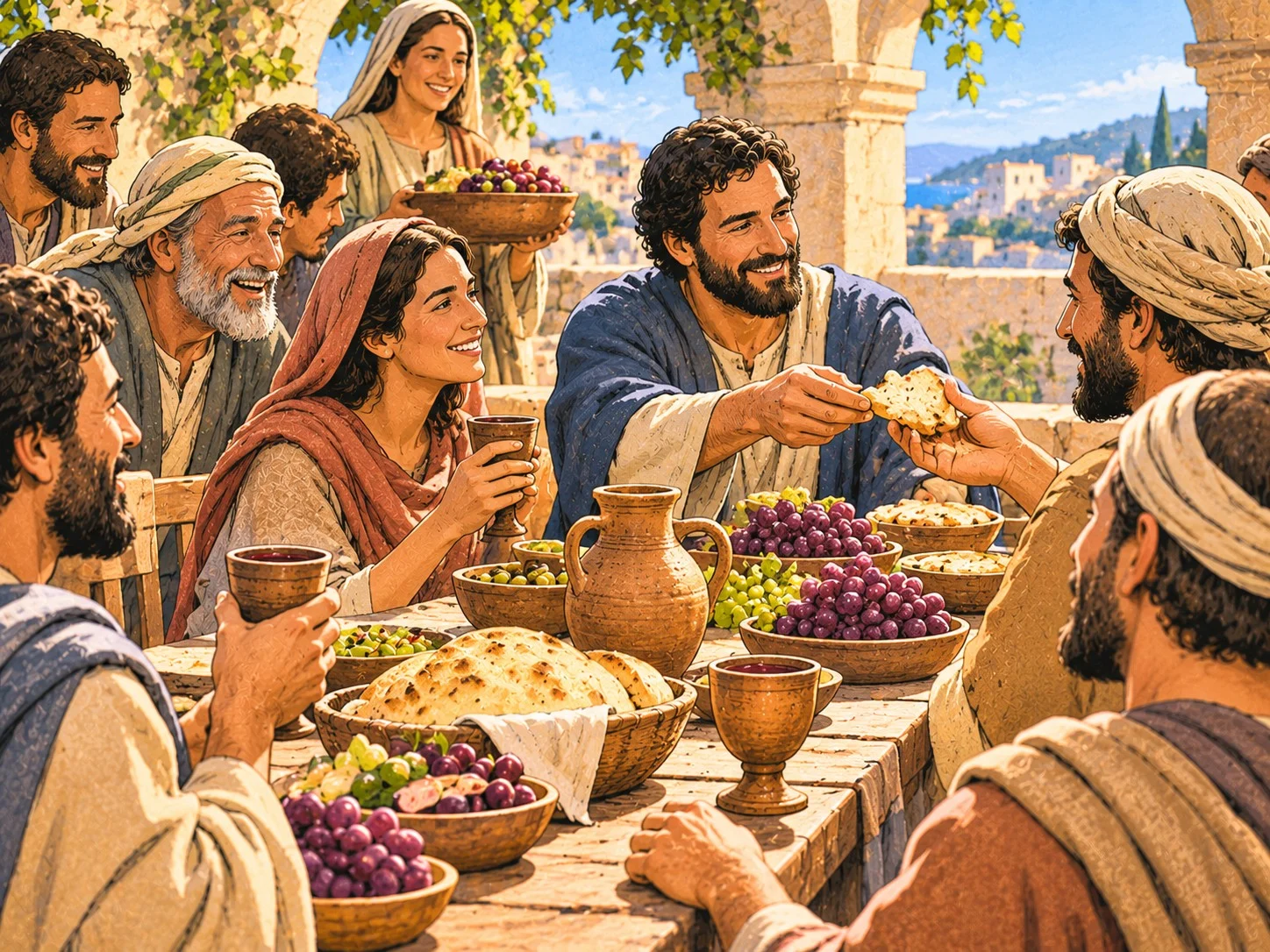
In the previous blog, we saw that Jesus did not institute a new ritual during His last Passover meal. He took the bread and the drinking cup that were already on the table and explained to His disciples what they represented. Bread and wine direct our attention to Christ, who died but was raised from the dead by God.
But how did this work among the first ecclesias? In 1 Corinthians 11, Paul describes a shared meal held by the believers in Corinth. And quite a few things went wrong there. What should have been a representation of fellowship, life, and joy had instead become a cause of division.
a shared meal
The Corinthians came together to eat with one another. Paul had no objection to that in itself, but he did object to the way they did it.
1 Corinthians 11 (based on ISA)
²⁰ When you come together in one place, it is not to eat a meal of the Lord.
²¹ For when eating, each one takes his own meal beforehand, and one is hungry while another is drunk.
This immediately shows that it was not about a small piece of bread and a sip of wine, as is customary today at “Holy Communion”. The Corinthians held a real meal, at which they ate and drank. So much so that some were drunk, while others went hungry.
Apparently, they did not take one another into account. Some had more than enough, while others lacked what they needed. What should have been a shared meal had become a shameful spectacle.
a meal worthy of the Lord
Paul says that their coming together in this way was not to eat the Lord’s supper. Does this mean that they should have held a particular religious meal? No, it is about the way they ate together.
The Greek word translated here as “the Lord’s” is kuriakon. It is an adjective derived from kurios, Lord. It literally means “of the Lord” or “belonging to the Lord”.
A meal belonging to the Lord should therefore also be a meal that is in accordance with Him. And that was precisely what was lacking among the Corinthians. The way they ate together was not in accordance with the Lord. Together they formed one body, with Christ as the Head, but they behaved as though they had nothing to do with one another.
The bread on the table was a representation of their unity in Christ. The wine spoke of the new life they shared in Him. But their behavior was exactly the opposite of what the bread and wine represented.
eating and drinking in an unworthy manner
A little further on, Paul uses words that are often applied very differently in Christian tradition.
1 Corinthians 11 (based on ISA)
²⁷ So then, whoever eats the bread or drinks the cup of the Lord in an unworthy manner will be guilty of the body and the blood of the Lord.
²⁸ But let a person test himself, and let him eat of the bread and drink from the cup in this way.
In many churches, this is understood as a call to examine yourself to see whether you are worthy to participate in “Holy Communion”. But that is not what Paul says at all. He does not speak of being unworthy, but of eating and drinking in an unworthy manner. That is an essential difference.
The Corinthians were not supposed to examine whether they were good enough to participate in the meal. They were supposed to ask themselves whether the way they ate and drank together corresponded to the meaning of that meal.
One was drunk and another was hungry. That was eating and drinking in an unworthy manner. Their behavior was not in accordance with the fellowship and unity they had in Christ.
discerning the body
Paul then says that they did not discern the body of the Lord (1 Cor. 11:29). That body is the ecclesia, the body of Christ. All believers are members of that one body, in which no one is more important than another (1 Cor. 12:12-27). Anyone who realizes this surely cannot sit calmly at the table eating and drinking while a fellow believer beside him goes hungry!
The Corinthians had no understanding of the meaning of their shared meal. In doing so, they disregarded the unity that God has brought about in Christ.
Paul even connects this with the weakness, sickness, and falling asleep of many among them (1 Cor. 11:30). He therefore takes their behavior very seriously. But even when the Lord judges them, it is to educate them and set them right (1 Cor. 11:32).
wait for one another
At the end of his explanation, Paul gives a remarkably simple instruction:
1 Corinthians 11 (based on ISA)
³³ So then, my brothers, when you come together to eat, wait for one another.
That is all. Paul does not prescribe that they should henceforth hold a separate, solemn ceremony. He simply tells them to wait for one another.
This involves more than merely waiting until everyone is present. It is about welcoming one another and taking one another into account. After all, they all belong to the same body.
A shared meal ought to be an expression of the fellowship we have in Christ. And the bread and wine on the table remind us of the wonderful reality that together we share in the life of our resurrected Lord.
That is a meal worthy of the Lord!
But in Israel, wine was not only drunk. Wine was also poured out with the sacrifices as a so-called drink offering. And remarkably, Paul later uses that image for his own life as well.
That is what the next blog is about.