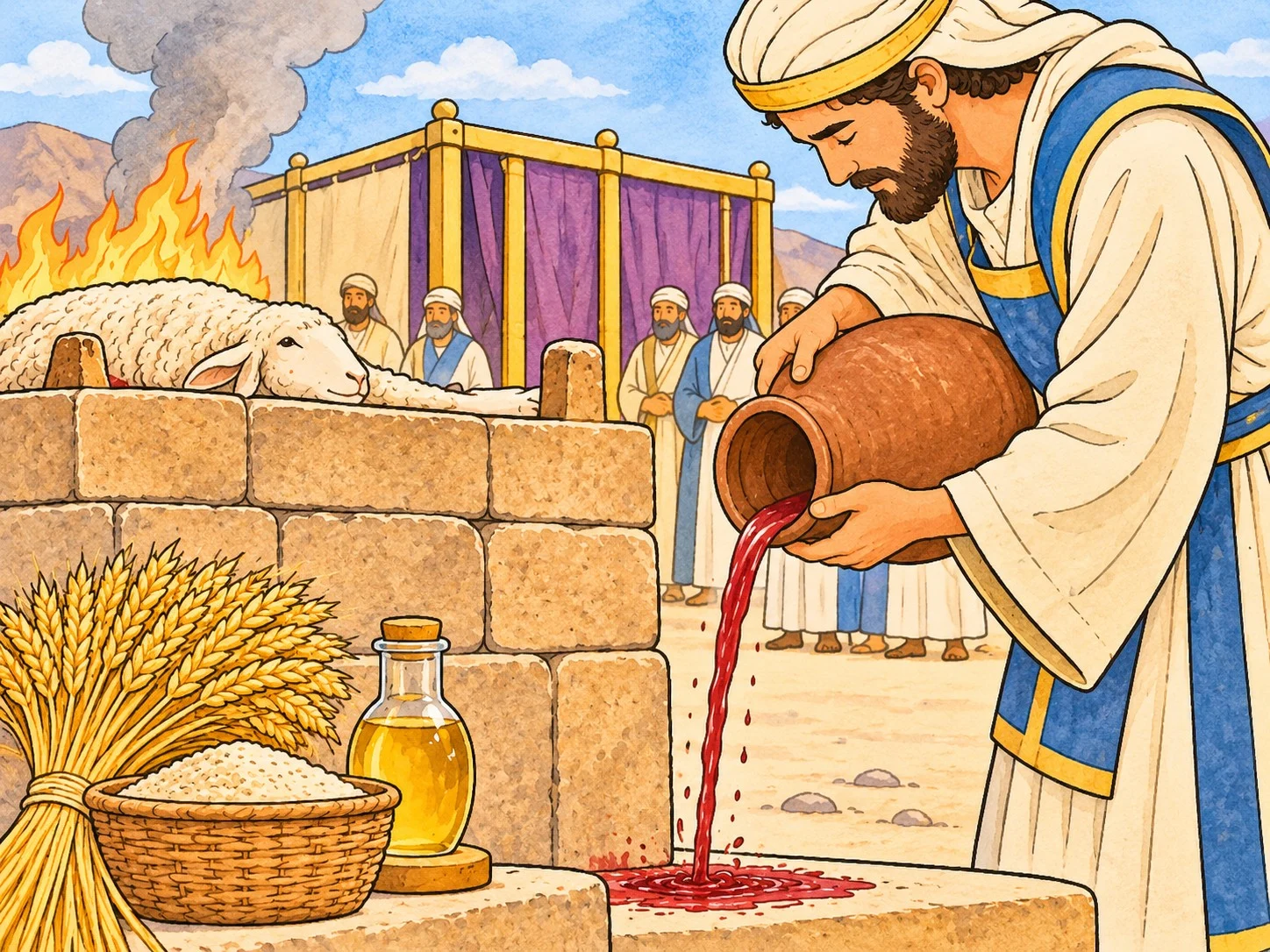
In the previous blog, we saw that the drinking cup is a representation of victory over death. The wine speaks of the life of the resurrected Christ, who has conquered death. But in Scripture, wine is not only drunk. Wine was also poured out with the sacrifices as a so-called drink offering.
What was its meaning? And why does Paul compare his own life to such a drink offering?
the drink offering
In Israel’s sacrificial service, various offerings were presented. Alongside the animal sacrifices, there were also grain offerings and drink offerings. With a drink offering, a certain amount of wine was poured out as part of the sacrificial service (Num. 15:5-10). The pouring out of wine is a remarkable image. After all, in the previous blogs we saw that wine speaks of new life, of resurrection life. And it was precisely this wine that was poured out with the sacrifices.
The sacrifices in Israel were foreshadowings of Christ. They concern not only His suffering and death, but above all His resurrection and exaltation. With the burnt offering, the slaughtered animal was placed on the altar, and the smoke rose upward to God as a pleasing aroma. The slaughtering is a representation of the death of Christ, while the raising onto the altar and the rising smoke speak of His resurrection and ascension.
The wine that accompanied the offering also speaks of that new life. After all, it is a spirituous liquid, a representation of the life that has been brought to light through death.
the first sheaf
We find a special example in Leviticus 23, where the appointed festivals of JAHWEH are described. At the beginning of the harvest, Israel was to bring the first sheaf to the priest. He would wave the sheaf before JAHWEH. On this occasion, a one-year-old lamb was also presented, together with a grain offering and a drink offering.
Leviticus 23 (based on ISA)
¹³ And its grain offering: two-tenths of fine flour, mixed with oil, a fire offering to JAHWEH, a soothing aroma, and its drink offering: a fourth of a hin of wine.
Why was wine poured out specifically with the first sheaf? The first sheaf is a beautiful representation of the resurrection of Christ. After all, Paul calls Him the Firstfruit of those who have fallen asleep.
1 Corinthians 15 (based on ISA)
²⁰ But now Christ has been raised from the dead, as Firstfruit of those who have fallen asleep.
The first sheaf announced the harvest that was still to follow. In the same way, Christ has been raised from the dead as Firstfruit. His resurrection guarantees the resurrection of all who follow afterward.
And wine was poured out with that first sheaf. Precisely at this festival, which points forward to the resurrection, we find wine as a representation of new life.
Paul as a drink offering
Paul also uses the image of a drink offering. In his letter to the Philippians, he writes:
Philippians 2 (based on ISA)
¹⁷ But even if I am being poured out as a drink offering upon the sacrifice and the service of your faith, I rejoice and rejoice together with you all.
Paul wrote these words from his imprisonment. He did not know what would happen to him. He might even be put to death. But notice how he puts it: even if I am being poured out as a drink offering. He is therefore not saying here that he will die, but that he is even prepared for that.
He compares his possible death to the pouring out of wine as a drink offering. The sacrifice and the service of the Philippians’ faith are, as it were, accompanied by the pouring out of his own life.
And what does Paul say about this? That he rejoices! Even if his life were to end through a violent death, that could not take away his joy.
For Paul knew the resurrected Christ. He knew that death does not have the final word. How, then, could he lose his joy?
the end of his course
A few years later, Paul writes his final letter, to Timothy. By then, his situation has changed. Whereas in Philippians 2 he still speaks of the possibility of his death, he now knows that the end of his earthly course is near.
2 Timothy 4 (based on ISA)
⁶ For I am already being poured out as a drink offering, and the time of my departure is at hand.
Once again, Paul uses the image of a drink offering. He has completed his course to the end and kept the faith (2 Tim. 4:7). His life is being poured out, but his expectation remains unchanged. He looks forward to the appearing of Christ and the wreath that is reserved for him (2 Tim. 4:8).
What a beautiful meaning the drink offering has. The wine is poured out, yet it speaks precisely of life and joy. Even if Paul were to lose his life, his expectation remained directed toward Him who has conquered death.
And this connection between wine and joy brings us to another remarkable statement by Paul. In Ephesians 5, he contrasts becoming drunk with wine with being filled in spirit.
What do wine and spirit have to do with one another?
That is what the next blog is about.