In the previous blog, we saw that Israel is represented in Scripture as a vine and a vineyard. But the vineyard did not produce the fruit God expected. Yet His promises have not thereby been annulled. God Himself will accomplish what He has promised.
This is illustrated in a remarkable way in the account of the wedding at Cana. There, the wine runs out, but Jesus turns water into wine. And the remarkable thing is that this is His first miraculous sign! So it is not merely a miracle, but a sign with a deeper meaning.
on the third day
John 2 begins with the statement that on the third day there was a wedding in Cana, in Galilee. That third day is significant. It is the day on which Christ was raised from the dead, but in the prophecies, the third day is also associated with new life. Thus Hosea says concerning the future restoration of Israel:
Hosea 6 (based on ISA)
² He will make us alive after two days, on the third day He will raise us up, and we shall live before His face.
How should we understand those two days? We find an indication of this in Peter:
2 Peter 3 (based on ISA)
⁸ But do not let this one thing escape you, beloved, that one day with the Lord is as a thousand years and a thousand years as one day.
When we apply this thought to Hosea’s prophecy, we understand the two days as a period of two thousand years. On the third day, Israel will be raised up again and live before the face of JAHWEH.
the wedding
The wedding is also a representation of that future restoration. The old covenant was a marriage covenant between JAHWEH and Israel, but the people had broken this covenant (Jer. 31:32). However, God has promised to make a new covenant with the house of Israel and the house of Judah (Jer. 31:31).
That new covenant is again presented in the prophecies as a marriage. JAHWEH will rejoice over Israel as a bridegroom rejoices over his bride (Isa. 62:5). It is therefore significant that Jesus is present at a wedding precisely on the third day.
they have no wine
During the wedding, a problem arises. The wine runs out! Jesus’ mother says to Him: “They have no wine” (John 2:3).
As we saw in the earlier blogs, wine is a representation of new life and joy. But here the wine is missing. And in this, we recognize the condition of Israel. The people had indeed received the promises, but did not yet possess the promised life.
Ezekiel 37 describes Israel as a valley full of dry bones. There, the people say that their bones have dried up, their expectation is lost, and they are cut off. But God promises that He will bring the people up out of their graves and put His spirit in them, so that they will live (Ezek. 37:11-14).
Israel has no life in itself. It is completely dependent on God, who will give life.
When Mary tells Jesus that there is no wine, He answers that His hour has not yet come. It is a matter of time. God has appointed His own time at which He will fulfill His promises.
from water to wine
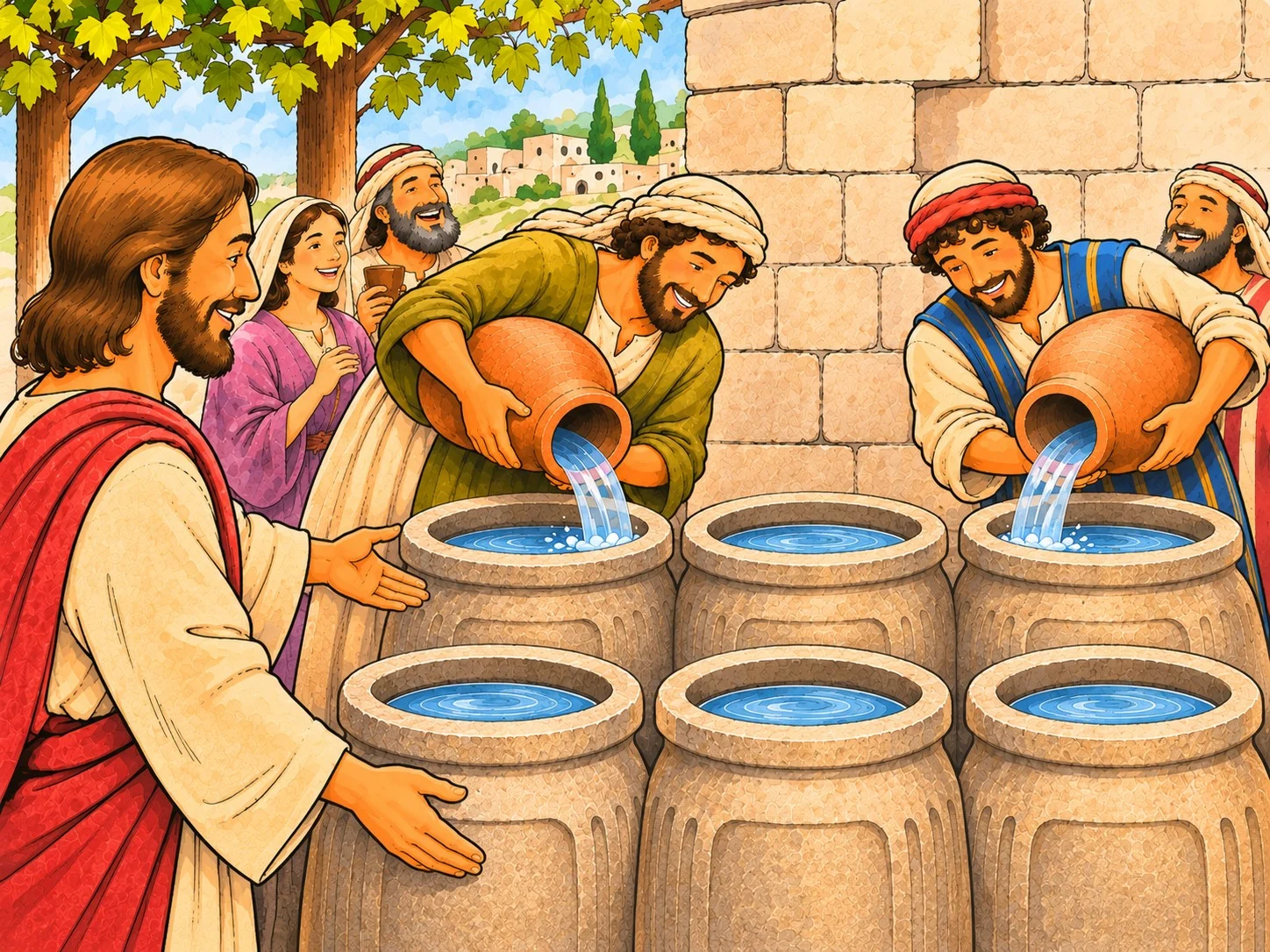
There are six stone water jars, intended for the purification rituals of the Jews. Jesus gives the command to fill these jars to the brim with water. And when the servants then draw water and bring it to the head of the dining hall, it turns out to have become wine!
Those six water jars speak of the old covenant, with its regulations and purification rituals. But that old covenant could not give Israel the promised life.
new covenant
Now the water becomes wine. What a beautiful representation of the new covenant! No longer a covenant in which Israel itself must meet the prescribed conditions, but a covenant in which God Himself will accomplish everything.
In Jeremiah 31, JAHWEH repeatedly declares what He will do. He will put His law within them and write it on their hearts. He will be their God, and they will be His people. The new covenant rests on God’s promises and His work. And the result is life in abundance!
We also find this reflected at Cana. The jars are filled to the brim. There is no question of just a little wine, but of an abundance.
the best wine for last
When the head of the dining hall tastes the wine, he calls the bridegroom. Normally, the good wine is served first, and afterward the inferior wine. But here it is exactly the other way around. The best wine has been kept until last (John 2:9-10).
In this, too, we recognize an important principle in God’s dealings. He takes away the first in order to establish the second (Heb. 10:9). The old covenant gives way to the new, which is so much more glorious. The best is yet to come!
The wedding at Cana is therefore a beautiful foreshadowing of the future restoration of Israel. On the third day, the new covenant becomes reality. The people who had no life receive new life. Where there was once lack, there will be abundance.
At the end of this account, John mentions that Jesus performed the beginning of His signs in this way and revealed His glory (John 2:11). That is what this sign ultimately points to: the glory of the resurrected Christ, who will fulfill His promises and establish His Kingdom.
But the Lord Jesus uses another image in which wine plays an important role. He speaks of new wine that cannot be put into old wineskins. Why not? And what is its meaning?
That is what the next blog is about.