In the previous blog, we saw that Samson had to abstain from everything that came from the vine. Remarkably, in Judges 14:5, he was right by the vineyards of Timnah. The promise of new life was close at hand, but he did not yet have a share in it.
We encounter the vine and the vineyard more often in Scripture, especially in the prophecies, where they have a special meaning. They are a representation of Israel and the promises God has given to this people.
a vine out of Egypt
In Psalm 80, Israel is portrayed as a vine that God brought out of Egypt. He drove the peoples out of the land and planted His vine there (Ps. 80:9-10).
God had delivered Israel from Egypt and brought the people into the promised land. He had set them apart to be a blessing to the other peoples (Ex. 19:5-6). Just as a vine is intended to bear fruit, so Israel was to be a blessing to the nations.
And as we saw earlier, the vine carries within it the promise of wine. Wine that speaks of new life and joy. The vineyard is therefore a beautiful representation of the promises God had given to Israel.
an unfruitful vineyard
Isaiah 5 also describes Israel as a vineyard. JAHWEH had done everything to make His vineyard fruitful. He had cultivated the ground, removed stones, planted choice vines, and hewn out a winepress. But when He expected fruit, the vineyard produced only wild grapes. Isaiah then explains the meaning of this imagery himself:
Isaiah 5 (based on ISA)
⁷ For the vineyard of JAHWEH of hosts is the house of Israel…
God had given Israel everything, but the people did not produce the fruit He expected. Instead of justice and righteousness, He found injustice and unrighteousness.
The Lord Jesus refers to this account in the parable of the wicked vineyard tenants (Matt. 21:33-46). In it, the owner of the vineyard sends his servants to collect the fruit. Eventually, he even sends his son, but he too, just like the servants, is rejected and killed.
The tenants are a representation of the leaders of Israel, who rejected the prophets and would ultimately also put God’s Son to death.
the true vine
Against this background, Jesus’ words in John 15 take on a special meaning. On the evening before He was to be crucified, He says to His disciples:
John 15 (based on ISA)
¹ I am the true Vine, and My Father is the Farmer.
He is the One in whom God’s promises are fulfilled. What Israel could not produce becomes reality through Him. For however many promises of God there are, in Him is the yes. Therefore, through Him is also the amen, to the glory of God through us (2 Cor. 1:20).
Jesus continues His teaching by comparing His disciples to branches. A branch cannot bear fruit by itself. For that, it must remain connected to the vine. Only in this way does it receive the life and nourishment needed to bear fruit (John 15:4-5).
pruning
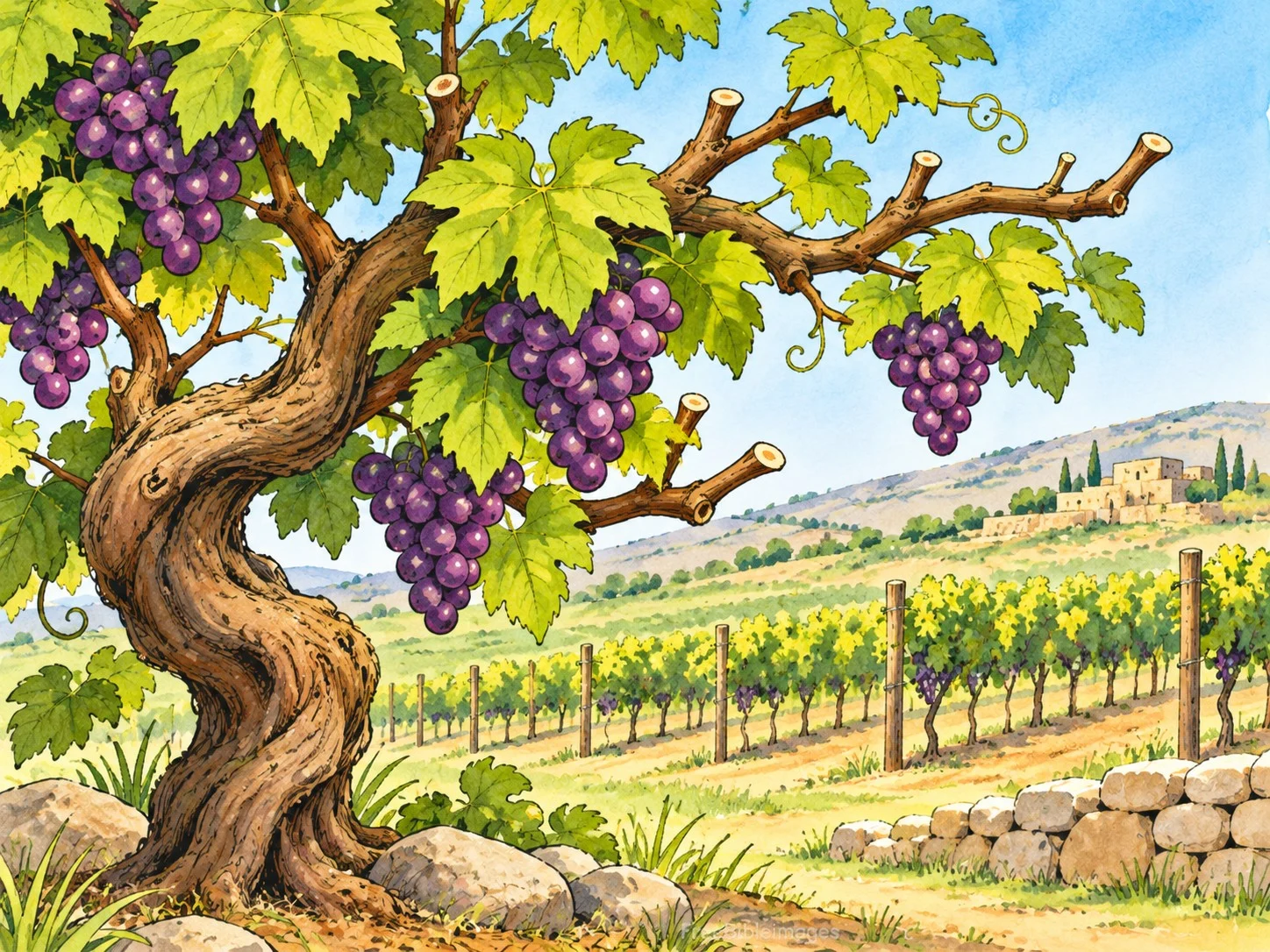
But a vine that is simply left to grow does not automatically produce a good harvest. The vine is a climbing plant that grows vigorously. That is why the farmer must prune it regularly and sometimes very severely. Otherwise, growth is directed mainly toward new shoots and leaves, at the expense of fruit development.
That is precisely what Jesus describes in verse 2. His Father is the Farmer, who cleanses every branch that bears fruit so that it may bear more fruit. The Greek word for cleansing also has the meaning of pruning here. And in the following verse, Jesus says that His disciples are already clean because of the word He has spoken to them (John 15:3).
So it is not about producing as much growth as possible, but about bearing fruit. And for that, it is necessary for the Farmer to intervene. Precisely by removing, He promotes fruitfulness.
the promise remains
Although Israel as a people proved unfruitful and was set aside, God’s promises have not thereby been annulled. After all, Paul says that the gracious gifts and the calling of God are irrevocable (Rom. 11:29). The vine may have proved unfruitful, but the promise of wine remains! For God Himself will accomplish what He has promised.
That brings us to a remarkable account in John 2. A wedding is being celebrated, but the wine runs out. There is no wine left! Until Jesus appears and turns water into wine. And not just any wine. The best wine is kept until last.
That is what the next blog is about.