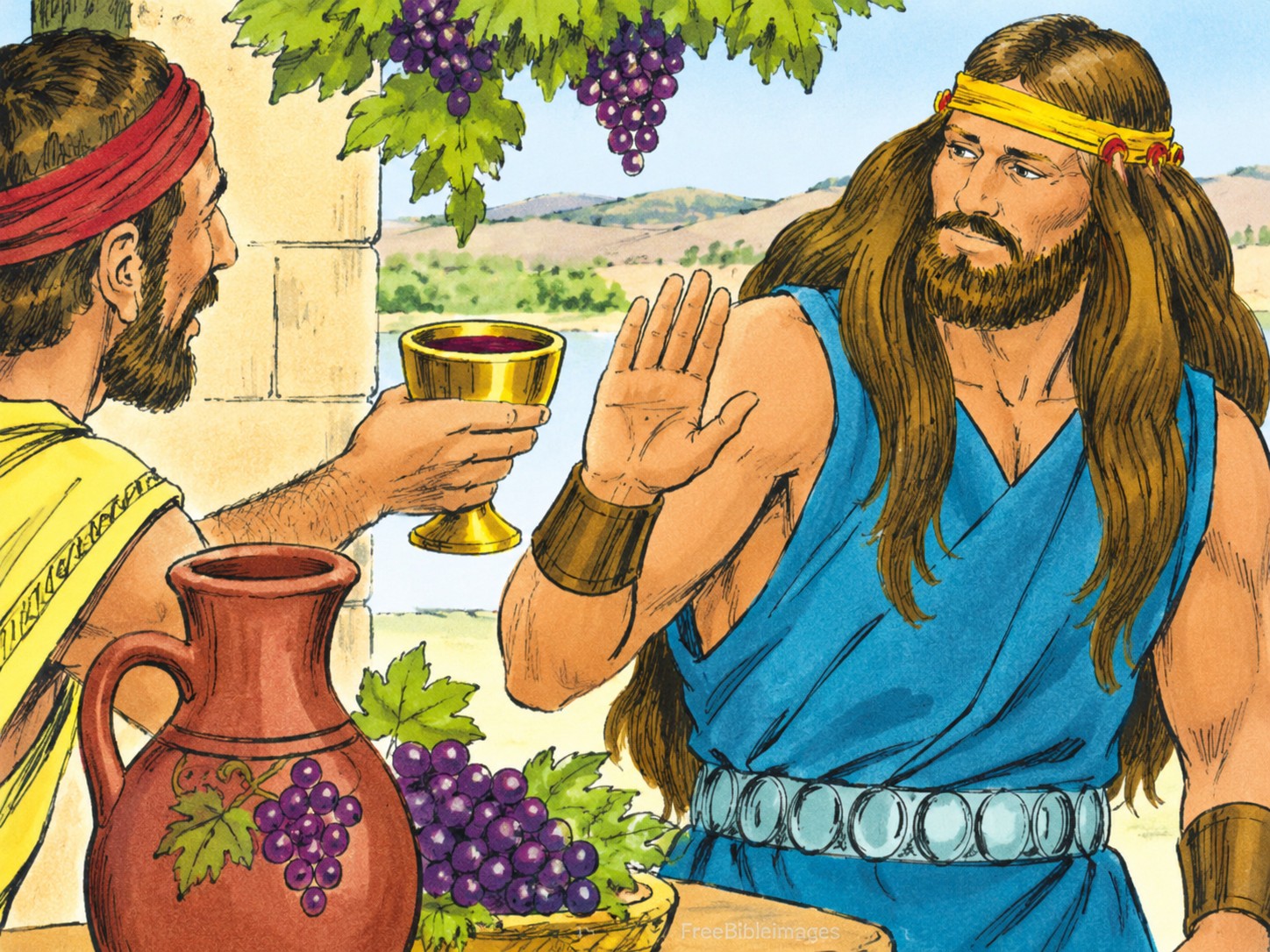
In the previous blogs, we saw that wine in Scripture is a representation of new life, of resurrection life. But that is precisely why it is remarkable that Samson was not allowed to drink wine. In fact, he was not even allowed to eat grapes, not even raisins, or consume anything that came from the vine.
Why was this forbidden to him? It is precisely in these regulations that we find a beautiful reference to Christ!
a Nazirite
Even before Samson was born, a messenger of JAHWEH appeared to his mother. She was barren, but received the announcement that she would give birth to a son.
Judges 13 (based on ISA)
⁴ And now, take heed to yourself and do not drink wine or strong drink, and do not eat anything unclean.
⁵ For behold, you shall conceive and give birth to a son, and no razor shall come upon his head, for from the womb the boy shall be a Nazirite of God. And He shall begin to deliver Israel from the hand of the Philistines.
Samson would be a Nazirite. That word means one who is set apart. The regulations for the Nazirite vow are found in Numbers 6. A Nazirite was not allowed to drink wine or strong drink, eat anything from the vine, cut his hair, or come into contact with a dead person (Num. 6:1-8). Usually, the Nazirite vow was for a certain period, but Samson would be a Nazirite from the womb until the day of his death (Judg. 13:7).
no wine
Samson is a foreshadowing of Jesus of Nazareth in His first coming. It was said of Samson that he would begin to deliver Israel from the hand of the Philistines (Judg. 13:5). The decisive victory over the Philistines would only be achieved later, under David (2 Sam. 3:18). David is a type of the resurrected Christ.
At His first coming, Christ came as a man, in humiliation, to suffer and die. His resurrection and glorification would only follow afterward. Samson therefore represents Him in His humiliation, while David is a foreshadowing of the resurrected and glorified Christ.
That is why Samson was not allowed to drink wine. After all, wine is a representation of resurrection life. For Christ, that life still lay in the future. First He had to suffer and die, and then be raised from the dead by His Father.
Samson’s long hair also fits this representation. Paul writes that long hair is a dishonor for a man (1 Cor. 11:14). It speaks of humiliation and shame. Christ humbled Himself, took the form of a slave, and became obedient unto death, even the death of the cross (Phil. 2:5-8).
John the Baptist
It is remarkable that we find something similar in the announcement of the birth of John the Baptist as in the case of Samson. The messenger Gabriel says to Zechariah:
Luke 1 (based on ISA)
¹⁵ For he shall be great before the Lord, and he shall certainly not drink wine or strong drink, and he shall be filled with holy spirit, even from the womb.
This strongly resembles the announcement of Samson’s birth in Judges 13:4-5. John, too, was not allowed to drink wine or strong drink. Although he is not explicitly called a Nazirite, we do find in him an important characteristic of the Nazirite vow.
John was the forerunner of Jesus. Just like Samson, we see in him a representation of Jesus of Nazareth in His first coming, when He still had to go the way of humiliation and suffering.
But notice what Jesus Himself says about the difference between John and Him:
Luke 7 (based on ISA)
³³ For John the Baptist came neither eating bread nor drinking wine, and you say: He has a demon.
³⁴ The Son of Man came eating and drinking, and you say: Behold, a glutton and a wine drinker, a friend of tax collectors and sinners!
What a remarkable contrast! John abstained from wine, but Jesus did drink wine.
As a forerunner, John pointed ahead to the One who was to come. In his abstinence from wine, we recognize the way of humiliation that Jesus first had to go. But Jesus Himself is the Christ, in whom the new life and the joy represented by wine would become reality.
The point here is not whether Jesus literally drank wine during His earthly life. After all, He did. It is about the meaning of the representation: first the way of humiliation and suffering, then the resurrection and glorification!
the joy set before Him
In Hebrews 12:2, these two thoughts are brought together in a beautiful way. Because of the joy set before Him, Christ endured the cross and despised the shame. We find the shame represented in Samson’s long hair. And the joy that lay before Him, we recognize in the wine from which Samson had to abstain.
But the Nazirite vow would not last forever. Numbers 6 describes what happened when the days of separation were fulfilled. Then sacrifices were offered, the long hair was shaved off, and subsequently we read:
Numbers 6 (based on ISA)
²⁰ And afterward the Nazirite shall drink wine.
What a meaningful sequence! First the separation and abstinence, then the wine. In Samson’s case, the Nazirite vow lasted until his death. And it is precisely in this that we find the reference to Christ. He went the way of humiliation and suffering to the very end. But afterward came His resurrection and exaltation! He despised the shame and received the joy that lay before Him. He is now seated at the right hand of the throne of God (Heb. 12:2).
the promise close at hand
It is also remarkable that Samson comes to the vineyards of Timnah in Judges 14:5. He was not allowed to eat or drink from the fruit of the vine, but he was very close to it. The promise of new life was, as it were, close at hand, but Samson was not yet allowed to partake of it.
In the same way, the Kingdom had drawn near when Jesus came to Israel (Matt. 4:17). But before the promises would be fulfilled, the Messiah first had to suffer and die.
That brings us to another question. Why is Israel in particular represented in Scripture as a vine and a vineyard? And why does Christ call Himself the true vine?
That is what the next blog is about.