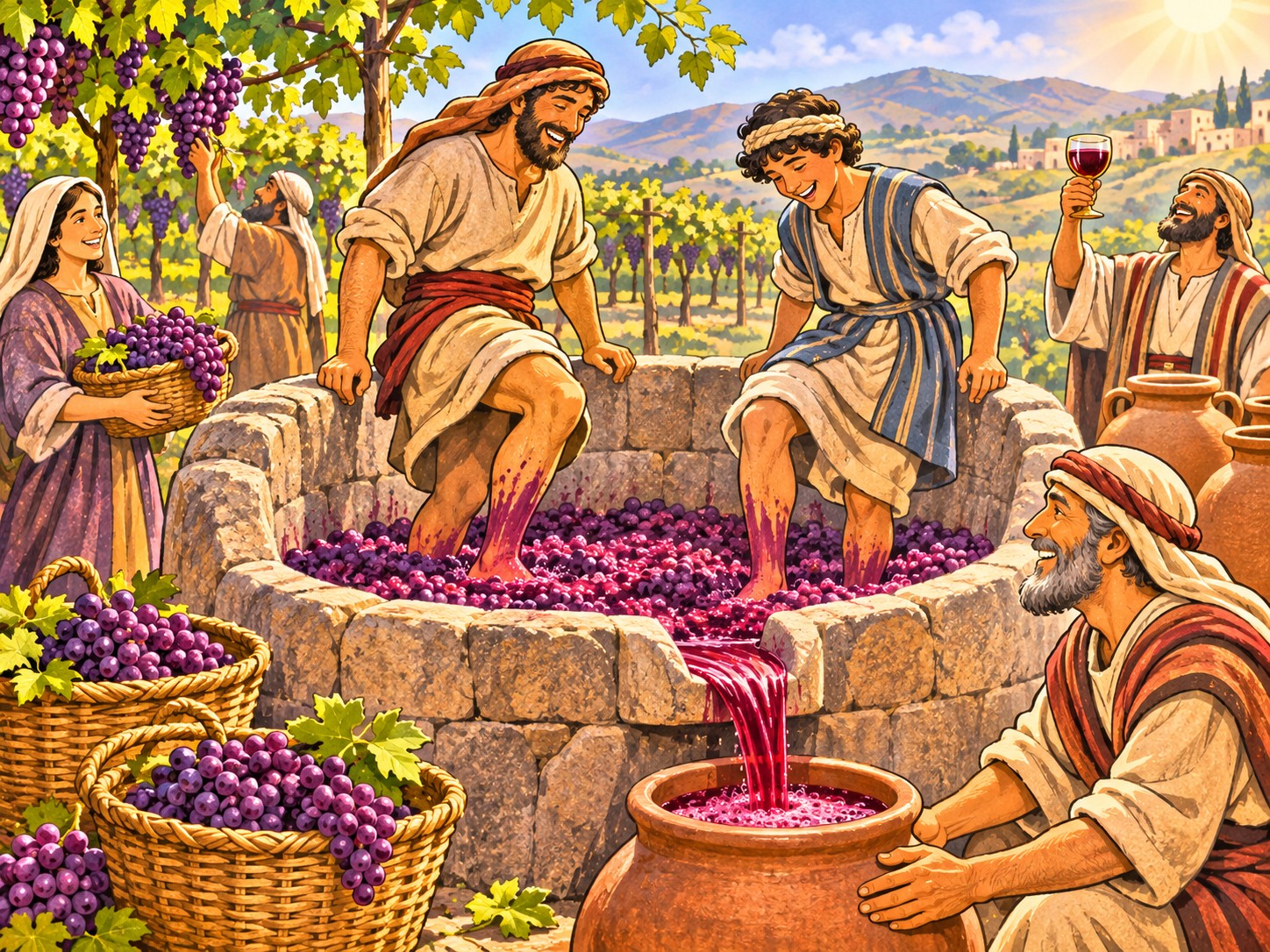
In the previous blog, we saw that wine in Scripture is a depiction of life and joy. But before there is wine, quite a lot has to happen. Grapes must be picked, trampled, and pressed. The juice is collected and undergoes a transformation before it emerges as wine.
In this process, we recognize the path Christ took: His suffering, death, burial, and resurrection. What begins with the trampling of grapes ends with wine that gladdens the human heart!
the winepress
From ancient times, grapes were trampled underfoot in a winepress. The grapes were crushed and ground so that the juice could flow out. It was then collected to be made into wine.
The trampling of the grapes is a depiction of the suffering and death of Christ. He was humiliated, oppressed, and crushed (Isa. 53:5). But it was precisely through His suffering and death that incorruptible life would be brought to light.
in concealment
The pressed grape juice is not yet wine. First, it must undergo a transformation. The juice was collected and stored in vessels. In earlier times, these were mainly earthenware jars, and later also oak barrels kept in wine cellars.
Inside the vessels, the grape juice undergoes a transformation through fermentation. The sugars are converted into alcohol. What was initially grape juice becomes spirituous liquid: wine.
All of this takes place out of sight. The vessels are kept in the concealment of the cellar (underground), and only later does the wine emerge. In this, we recognize a beautiful depiction of the burial and resurrection of Christ. His body was laid in a tomb, hidden from the eyes of men. But the tomb was not His final destination!
God roused Him from the dead. He emerged from the tomb as the Firstfruit of those who have fallen asleep (1 Cor. 15:20). Not to die again, but as the Conqueror of death, with incorruptible life.
Pharaoh’s cupbearer
In the account of Joseph, we also find a remarkable reference to wine and resurrection. While Joseph is in prison, he is given two dreams to interpret. One of them is the dream of Pharaoh’s cupbearer.
Genesis 40 (based on ISA)
⁹ And the chief of the cupbearers recounts his dream to Joseph, and he says to him: In my dream, behold, a vine was before me.
¹⁰ And on the vine were three branches, and as soon as it began to bud, its blossoms came forth, and its clusters bore ripe grapes.
¹¹ And Pharaoh’s cup was in my hand. And I took the grapes, and I pressed them into Pharaoh’s cup, and I gave the cup into Pharaoh’s hand.
The cupbearer sees a vine with three branches. Blossoms and ripe grapes appear on them, which he presses into Pharaoh’s cup.
Joseph then explains that the three branches represent three days. Within three days, Pharaoh will lift up the cupbearer’s head and restore him to his position (Gen. 40:12-13). And that is exactly what happens. On the third day, the cupbearer is brought out of prison and restored to his position (Gen. 40:20-21). What a beautiful depiction! The vine bears fruit, the grapes are pressed, and on the third day the cupbearer is exalted.
This reminds us of Christ, who was roused from the dead on the third day. But He is not the only One who shares in that new life. All who believe in Him are united with Him in His death and resurrection.
Romans 6 (based on ISA)
⁴ We were then buried together with Him through baptism into death, so that, just as Christ was roused from the dead through the glory of the Father, so we too might walk in newness of life.
from suffering to glory
The process from grape to wine reminds us of a tremendous truth. The suffering and death of Christ were not the end, but the way through which God brought incorruptible life to light.
The grapes are trampled, the juice is hidden from sight, but eventually wine emerges. Wine that gladdens the heart!
And that new life is not intended for just a few. Christ is the Firstfruit, and ultimately all will be vivified in Him (1 Cor. 15:22).
But if wine is such a beautiful depiction of resurrection life, why was Samson not allowed to drink it? Not only was wine forbidden to him, but even grapes and everything that came from the vine.
We will examine that more closely in the next blog.